

Bitcoin is once again facing notable selling pressure. The market confronts a challenging phase marked by weakening momentum and cautious investor positioning. Recent price action suggests that bullish conviction has softened. Traders are increasingly attentive to liquidity conditions, macro uncertainty, and shifting market sentiment. While volatility is not unusual at this stage of the cycle, the current environment reflects a market searching for direction rather than sustaining a clear upward trend.
A recent CryptoQuant report provides additional context through Bitcoin’s Combined Market Index (BCMI), a composite metric that integrates valuation, profitability, spending behavior, and sentiment indicators. According to the analysis, BCMI has fallen into the low 0.2 range, a level historically associated more with early bear market phases — such as those seen in 2018 and 2022 — rather than routine mid-cycle corrections. This shift suggests a deeper structural adjustment may be underway.
Notably, BCMI was hovering near 0.5 as recently as October, a zone typically interpreted as market equilibrium between bullish and bearish forces. The subsequent decline indicates that this balance has broken down. Whether this signals the start of a prolonged bearish phase or a temporary reset will likely depend on future liquidity conditions, investor demand, and broader macroeconomic developments.
BCMI Breakdown Points To Structural Weakness In Bitcoin Market
The CryptoQuant report highlights a notable deterioration in Bitcoin’s Combined Market Index (BCMI), suggesting a shift away from mid-cycle consolidation toward a more defensive market regime. According to the analysis, the mid-cycle equilibrium around the 0.5 level failed to hold, with no meaningful rebound emerging from the 0.3 zone.

Instead, the index continued declining directly toward the low 0.2 range without the type of expansion reset typically seen during healthier corrective phases. This pattern differs from past mid-cycle cooling periods and increasingly resembles a transition into a risk-off market environment.
Historical comparisons provide additional perspective. Previous cycle bottoms generally formed when BCMI reached approximately 0.10–0.15, notably during 2019 and again in the 2022–2023 bear phase. Current readings remain above those capitulation levels, implying that while Bitcoin may already be operating within a bearish structural framework, full capitulation conditions have not yet materialized.
Because BCMI aggregates valuation metrics such as MVRV, profitability indicators like NUPL, spending behavior via SOPR, and broader sentiment measures, its decline into the low 0.2 range reflects shrinking unrealized profits, rising realized losses, deteriorating sentiment, and ongoing valuation compression. Unless the index stabilizes and reclaims the 0.4–0.5 zone, the probability of continued structural weakness remains elevated.
Bitcoin Tests Long-Term Support After Weekly Breakdown
Bitcoin’s weekly chart reflects increasing structural pressure following the recent loss of the $70,000 level, a key psychological and technical threshold that had previously acted as support. Price has now retreated toward the mid-$60,000 range, placing BTC below shorter-term trend averages and signaling weakening bullish momentum. This shift suggests the market is transitioning from consolidation toward a more defensive phase.
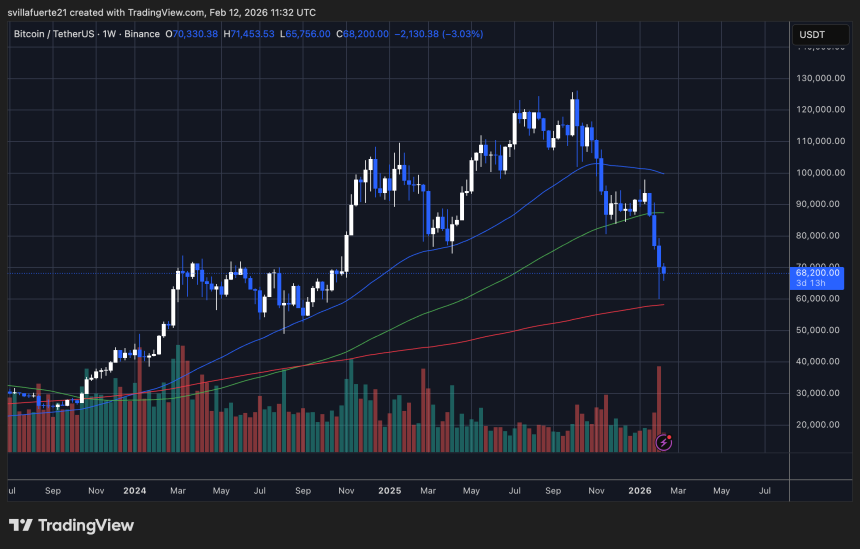
The chart shows a clear sequence of lower highs since the late-cycle peak near the $120,000 region. A pattern often associated with corrective or transitional market environments. Recent declines have been accompanied by elevated trading volume. Typically indicative of distribution or forced deleveraging rather than gradual profit-taking. Such dynamics often increase volatility while complicating sustained recovery attempts.
From a structural perspective, the $60,000–$62,000 zone emerges as a critical support area. This region aligns with prior consolidation phases and high-liquidity trading zones that historically attracted demand. Holding above this level could allow Bitcoin to stabilize and potentially form a base for sideways consolidation. However, a decisive breakdown would raise the probability of deeper retracement scenarios.
Bitcoin’s direction remains closely tied to liquidity conditions, institutional flows, and broader macro sentiment influencing risk assets.
Featured image from ChatGPT, chart from TradingView.com