Privacy networks like Beldex focus on long-term sustainability through steady expansion and adoption driven by strong protocol design, continuous R&D, and real-world usability. This infrastructure-first approach is now attracting measured attention beyond the core ecosystem.
For instance, Grayscale , in its broader discussion of leading privacy-focused digital assets, has included Beldex among a wider set of privacy coins, an indication of growing relevance within the privacy infrastructure space.
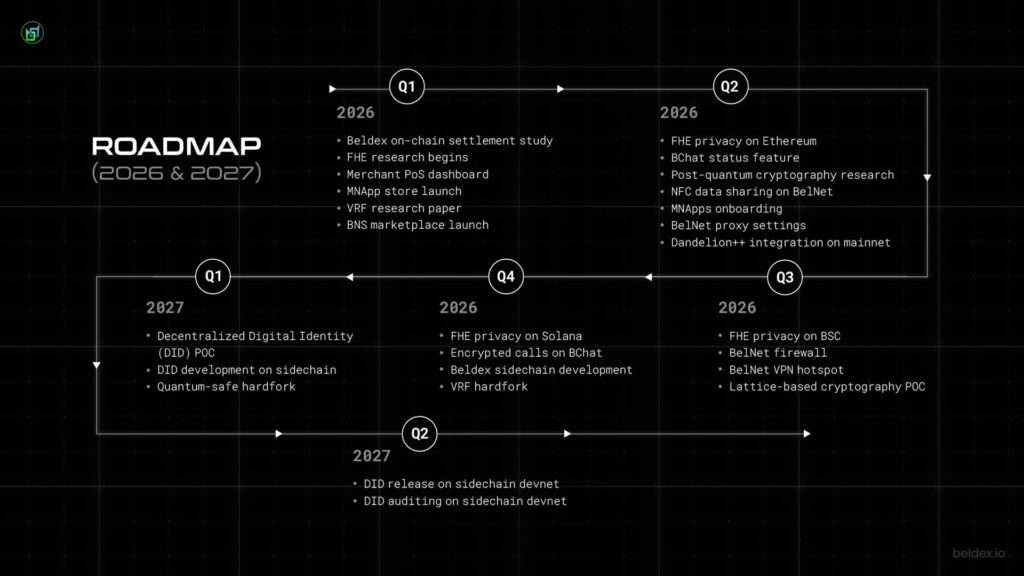
For Beldex, 2026 represents a key phase where infrastructure and expanding real-world usability take precedence. The broader objective is to ensure that privacy-preserving systems can function reliably in real economic environments. The first quarter of 2026 lays the groundwork for future growth, not only for Beldex, but for how private blockchain infrastructure can support global digital activity.
On-Chain Settlement & FHE Research
As blockchain adoption increases, on-chain efficiency becomes a core factor for scalability and trust. In Q1 2026, Beldex initiated research into scaling on-chain settlement, exploring how higher transaction throughput can be achieved while preserving privacy and keeping all settlements native to the Beldex mainnet. On-chain settlement reduces dependency on external layers and improves deterministic execution, an essential requirement for complex, high-volume use cases and complements real-world adoption.
At the same time, Beldex is initiating research into
Fully Homomorphic Encryption (FHE)
, a cryptographic approach that allows computation on encrypted data without revealing the data itself. It is a long-term groundwork helping the network evaluate realistic future applications.
Dandelion++: Network Layer Privacy
Dandelion++ is a network layer upgrade which is aimed at reducing the traceability of transactions back to their origin, specifically, protecting the IP address of the block producer. Instead of immediately broadcasting the transactions to all the nodes in the network, it uses a two-phase propagation model, the stem phase and the fluff phase.
In the stem phase, the block producer relays transactions through a randomized path across nodes. Once the origin is sufficiently obfuscated, the subsequent fluff phase begins. Transactions are only broadcast during the fluff phase, making it significantly harder to correlate transaction timing or network position with the originating node. In essence, Dandelion++ complements on-chain privacy at the network layer, by obscuring the origin of transactions.
Consensus Evolution: Verifiable Random Functions
Verifiable Random Functions (VRFs) on the Beldex network represent a consensus-level upgrade aimed at enhancing the core consensus mechanics. At a fundamental level, VRF improves how randomness is generated and verified, ensuring outcomes that are both unpredictable and provably fair. This randomization reinforces network security, particularly for processes that require unbiased selection and secure validation.
In Q1 2026, Beldex will publish the VRF-based consensus as a research paper for peer review, outlining the design, security assumptions, and implementation approach behind the upgrade.
By enhancing randomness integrity, the VRF consensus will help protect the network from manipulation and strengthen overall trust. This upgrade is part of Beldex’s continuous protocol evolution, designed to improve security and performance while ensuring existing operations run seamlessly.
Driving Real-World Adoption: Merchant POS Dashboard
In Q1 2026, Beldex will introduce a dedicated Point-of-Sale (POS) dashboard designed specifically for merchants, making in-store crypto-based payments simple and accessible. The dashboard is built to streamline business operations by reducing the technical barriers typically associated with blockchain transactions.
The POS dashboard will monitor confirmation and settlement status easily while offering a user-friendly interface designed for non-technical business owners
By combining these features, the POS dashboard will empower merchants to integrate BDX payments into daily operations. This approach extends digital payments beyond crypto-native users, enabling businesses of all sizes to accept payments privately and efficiently, while fostering real-world commerce on a decentralized network.
Expanding the Ecosystem: MNApp Store Launch
Ecosystem sustainability depends on active developer participation and accessible distribution. MNApps are web applications hosted using the .bdx domains and leverage the Beldex masternode infrastructure. They’re hosted behind the BelNet onion-router, which ensures a high degree of privacy. The MNApp Store will provide a unified environment for publishing, discovering, and accessing web applications built on Beldex’s masternode infrastructure.
Rather than relying on fragmented discovery channels, the store creates a unified access layer that strengthens the entire ecosystem. Developers gain visibility, users gain discoverability, and increased masternodes will enhance network utility. Over time, this structured approach supports the emergence of privacy-focused applications, helping Beldex evolve into a thriving ecosystem.
Private Digital Identity: BNS Marketplace
The Beldex Name Service is a decentralized naming system on the Beldex network that maps human-readable identifiers to on-chain addresses and services. Users can buy BNS names via the Beldex Electron wallet, Beldex mobile wallet and the Beldex CLI wallet.
The upcoming BNS Marketplace will provide a decentralized platform to buy, sell, and manage blockchain-based domain identities within the Beldex ecosystem. These human-readable domains connect users seamlessly to multiple services while maintaining privacy and on-chain ownership.
Within the Beldex ecosystem, BNS domains are designed to integrate seamlessly across core products:
- Beldex Wallet: BNS names replace long wallet addresses, letting users send and receive BDX using easy names like Alice.bdx .
- BChat: BNS names act as BChat IDs, replacing alphanumeric IDs with readable usernames for private communication on the BChat private messenger.
- BelNet: BNS domains work as decentralized website names (e.g., MySite.bdx ), enabling access to confidential apps through BelNet’s onion-router based network.
- Beldex Browser: BNS domains, accessible via the Beldex browser, make it easier to access decentralized apps and private services across the Beldex ecosystem.
The marketplace enables secure ownership and transfer of domains, enhancing usability and identity continuity for individuals. For businesses and creators, BNS domains act as branding assets, building trust and recognition. By facilitating transactions and sustained use, the BNS Marketplace will become both a utility hub and revenue driver for the network.
A Foundation for What’s Coming Next
Beldex’s 2026 roadmap prioritizes infrastructure, adoption, and ecosystem depth as core drivers of sustainable growth. Consensus and protocol research, network upgrades, dApp upgrades, merchant tools, marketplaces and private identity layers are interconnected components which will strengthen the network as a whole. This approach ensures that scalability and usability advance while complementing privacy and long-term stability.
As Beldex moves in 2026, this foundation enables broader use cases and more sophisticated, yet user friendly applications to emerge. With core systems in place, upcoming phases can focus on expanding functionality, increasing adoption, and integrating privacy-preserving technology into real-world digital economies.