

During what many anticipated would be the year of a major Bitcoin (BTC) bull run, market expert Axel Adler has revealed that the leading cryptocurrency finds itself at the midpoint of a bear cycle.
A Mild Bear Cycle Compared To History
As of now, Bitcoin has recorded a modest year-to-date decline of 4%. However, the cryptocurrency has shown some stability this week, consolidating in the range of $89,000 to $94,000, with the latter figure serving as immediate resistance.
According to Adler, this current correction, which stands at approximately -32%, is considered less severe compared to previous bear cycles. He emphasizes that approximately 88% of Bitcoin holdings remain in unrealized profit, while only about 12% of the total supply is currently at a loss.
Adler points out that Bitcoin’s price action has remained relatively steady within the $90,000 zone, reflecting a mild drawdown in historical context.
The crucial question as the year approaches its end is whether this correction will stabilize between -35% and -40% from its all-time high , indicating a new, more “flattened” cycle, or if the market will follow historical trends that typically lead to deeper declines of -60% to -70%.
Analyzing past cycles, Adler notes that major bear markets in 2011, 2016, 2019, and 2023 were characterized by a significant increase in the percentage of coins at a loss, often rising to around 60%. These levels typically marked capitulation points in the market.
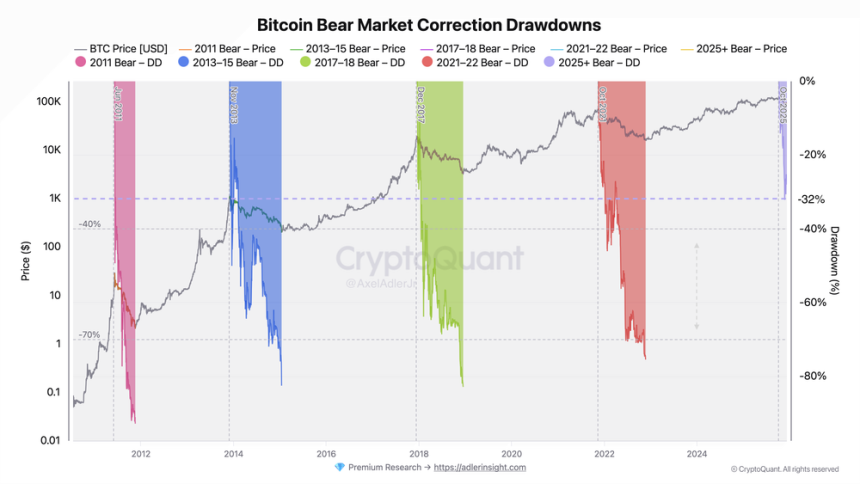
In contrast, the current landscape shows only 12% of holders experiencing unrealized losses , which diverges sharply from the patterns observed during past bear markets.
Can Bitcoin Avoid Deeper Declines?
The expert further noted that during recent local cycle peaks, only about 17% of coins were in the red, a figure that remains three to four times lower than traditional capitulation levels.
This unusual configuration suggests that the current market may resemble a correction within a bullish supercycle rather than the final downturn of a full-blown bear market.
Adler believes that the market appears to be testing the resilience of this correction structure, which stands at -32% from its peak, while maintaining a high ratio of profitable positions.
He argues that if Bitcoin can sustain this maximum drawdown above the -35% zone alongside moderate unrealized losses, it could bolster the case for a shift towards more “flat” corrections influenced by institutional demand and a structural supply deficit.
On the contrary, should Bitcoin’s correction extend beyond the -40% mark, the likelihood of entering a classic bear market increases significantly. Such a scenario would pave the way for deeper declines, potentially reaching the -60% to -70% range, and could trigger a full capitulation phase in terms of unrealized loss metrics.

At the time of writing, the market’s leading cryptocurrency is trading at $93,000, marking gains of 5% and nearly 9% in the 24-hour and 14-day time frames, respectively.
Featured image from DALL-E, chart from TradingView.com