
$1,000 controls about $6,450 of a single US stock. That arithmetic is the whole case, and on Nov. 10 the Securities and Exchange Commission told a Manhattan court it should stay that way.
The SEC filed an amicus brief in Capital Markets Alliance Association v. CFTC , No. 1:26-cv-09608 (S.D.N.Y.), backing the Commodity Futures Trading Commission’s decision to let three of its registered venues list perpetual futures on individual equities. KalshiEX, Coinbase Derivatives and Bitnomial Exchange began offering the contracts on Nov. 3, after the CFTC let a 45-day review under Regulation 40.3 expire without objection and treated the products as security futures under the Commodity Futures Modernization Act of 2000.
The Capital Markets Alliance, a New York trade group whose members include Cboe Global Markets, Citadel Securities and the Healthy Markets Association, sued the same day to vacate the approvals. Its argument is jurisdictional: a contract with no expiry is a security-based swap, and Congress gave the SEC exclusive authority over those. The SEC’s brief does not say that. It backs its sister agency.
That is the contradiction worth trading around. The agency the plaintiffs say has exclusive jurisdiction has now told the court the other agency got the classification right — while the judge who refused to freeze the products wrote that they look like swaps.
Six-to-one is where the argument actually lives
Strip out the statutory language and the product is simple. A perpetual future tracks a stock’s price with no expiration date. Instead of settling, longs and shorts exchange a funding payment on a schedule, and the price stays near spot because that payment makes holding the wrong side expensive.
The leverage is what makes it a different animal from a stock position. The approved contracts require minimum margin of roughly 15% to 15.5%, according to the amicus brief Better Markets filed on Nov. 10 in support of the plaintiff. Put up $1,000 and you carry $6,450 to $6,667 of stock-price exposure.
Buy the same stock on margin at a US broker and Regulation T requires 50%. One thousand dollars buys $2,000 of stock. The gap between the two products is not a rounding difference: it is 3.2 times the exposure for the same capital.
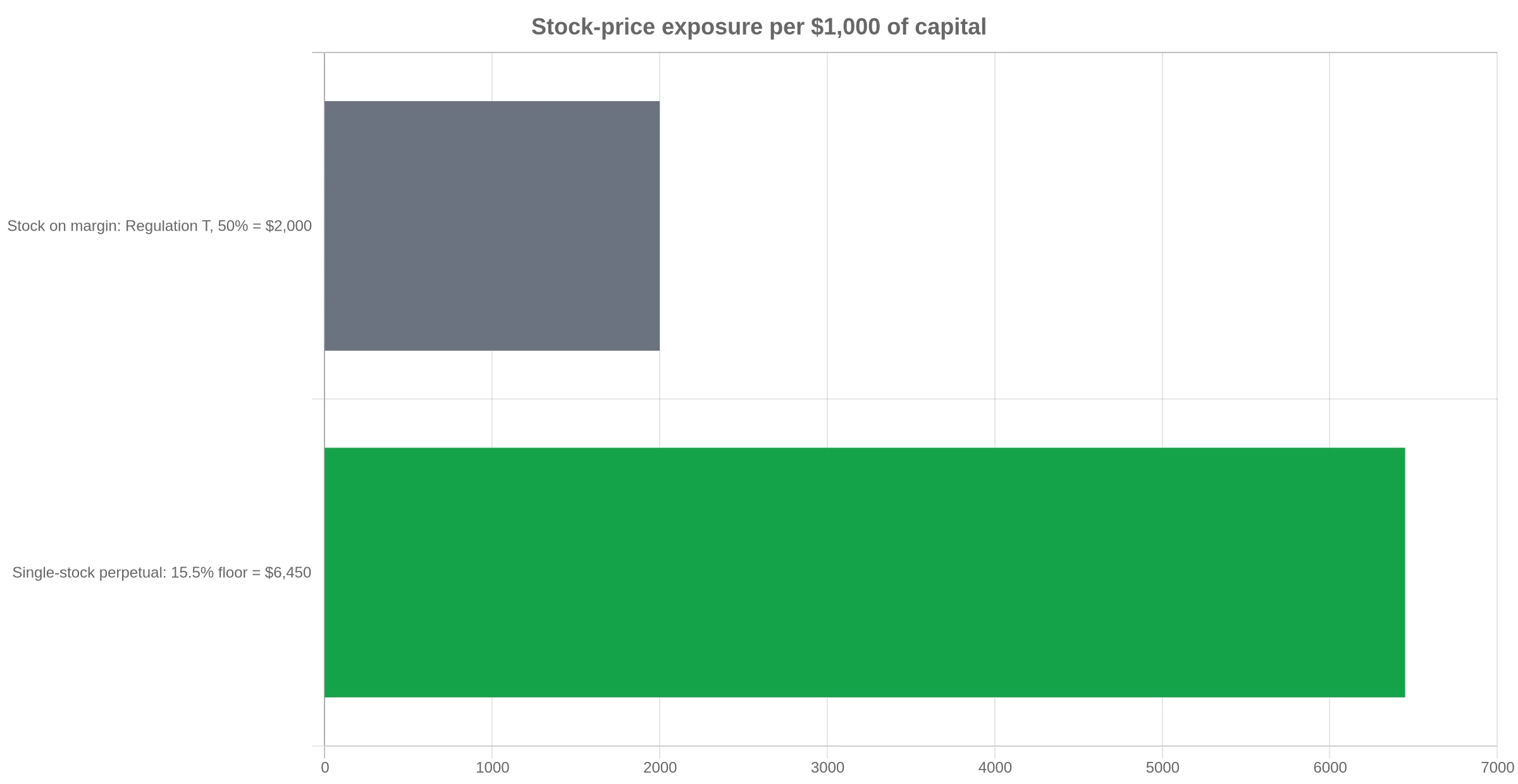
Capital needed to control $100,000 of a single US stock. Regulation T requires 50% initial margin under 12 C.F.R. § 220.12; the security-futures floor is 15% under 17 C.F.R. §§ 41.45(b)(1) and 242.403(b)(1). Chart: BlockchainReporter, from the regulatory figures cited in the Nov. 10 amicus brief.
The second number matters more than the first. At 6.45 times leverage, a 15.5% decline in the underlying stock wipes out the position completely. Not a drawdown. Zero equity, and the venue closes it automatically, whether or not the stock recovers the following week.
A 2x leveraged single-stock ETF, the closest domestic product, takes a 50% move to do the same damage, and the holder is never margined out. That is a 3.2-times tighter liquidation distance on the perpetual, on an instrument that tracks one company rather than an index.
| Feature | Single-stock perpetual future | 2x single-stock ETF | Stock on margin |
|---|---|---|---|
| Initial capital for $100,000 exposure | $15,500 (15.5% margin) | $50,000 | $50,000 (Reg T) |
| Move that erases equity | About 15.5% | About 50% | About 50%, with a margin call first |
| Expiry | None; funding paid indefinitely | None | None |
| Dividends or voting rights | None | None | Yes |
| Securities Act registration statement | None | Yes | Issuer-level registration |
What the SEC told the court, and what it left out
The SEC’s brief argues that security futures already sit inside a joint oversight structure: the venues are registered with the SEC as notice-registered national securities exchanges for security-futures trading, their listing standards are filed with the SEC, and antifraud and antimanipulation rules apply.
Better Markets, filing with former SEC Commissioner and Acting Chair Allison Herren Lee and Harvard law professor John C. Coates, reads the brief as answering a narrower question than the one the court asked. Its filing concedes that “a security future is subject to a limited set of securities law protections — antifraud, antimanipulation, etc.” Then it goes for the gap: what the SEC “neglects to mention” is the registration requirement that applies to security-based swaps, which carries strict liability for material misstatements and a rescission right for buyers.
“Remarkably, the SEC submitted a last-minute amicus brief in this case that goes to great lengths to tell the Court nothing of consequence,” the Better Markets brief states.
That is advocacy, not a ruling. But the underlying point is checkable in the statute: if the contracts are swaps sold to anyone who is not an eligible contract participant — a category that excludes ordinary retail investors — the Securities Act requires an effective registration statement, and the trade must happen on a Section 6(b) exchange. Neither condition describes a CFTC-registered designated contract market.
Note what the SEC’s brief does not do. It does not ask the court to dismiss the suit. It does not opine that a perpetual is a future. It supports the CFTC’s approval without adopting the CFTC’s reasoning in full, which leaves the classification question exactly where the plaintiff wants it: with the judge.
The judge already wrote the sentence the plaintiff needed
On Nov. 3 the court denied the Capital Markets Alliance’s request for a temporary restraining order, finding the group had not shown irreparable harm from products that had been trading for hours. It also said the plaintiff was likely to succeed on the classification question.
The order’s language, as quoted in the Better Markets brief, is blunt: “The CFTC’s actions seem to represent a major disruption to the equities market, and the public.”
Read that carefully before assuming the SEC’s intervention settles anything. A denied TRO is a ruling about timing and harm, not about merits. A preliminary injunction is a different standard, and that is what is still pending, along with a request to stay the approvals under 5 U.S.C. § 705 while the case runs.
The court also framed the statutory question in a way that cuts against the CFTC. A security future is defined as a contract for future delivery of a single security. The order held the perpetuals “by definition, do not provide for a ‘sale for future delivery of a single security'” and therefore cannot be one.
Three venues, one product, 45 days of silence
The CFTC’s own framing is that this is about keeping activity onshore. In the statement releasing the approvals on Nov. 3 , Chairman Michael S. Selig said the contracts “can begin trading for the first time on CFTC-registered exchanges.”
Selig also argued the alternative is worse, and made the jurisdictional politics explicit: “For too long, regulatory uncertainty left innovative products, such as security futures and equity perpetual futures, stranded in what SEC Chairman Paul S. Atkins has aptly described as a regulatory ‘no man’s land’ due to a lack of harmonization between the agencies.”
That sentence is doing real work. It describes the SEC and CFTC as partners who have resolved a turf problem, which is the opposite of what the plaintiff argues. It also dates the shift: the two agencies signed a memorandum of understanding earlier in 2026, and in June they opened a joint request for comment on how to define a swap against a security-based swap. That request is still pending. The CFTC answered the classification question for these three venues before the comment period closed.
The plaintiff’s read is that the sequence was reversed on purpose. “The hasty roll out of financial products that circumvent well-established regulatory frameworks erodes investor protection and undermines the integrity and resiliency of the American financial system,” Adam Ford, secretary of the Capital Markets Alliance, said in the group’s Nov. 3 statement announcing the suit .
The other side has a statute and an embarrassing letter
The CFTC’s defenders are not relying on the SEC to win. In a brief filed with Coinbase, Kalshi, Bitnomial and a wider coalition , Paradigm argues that the Commodity Exchange Act defines a security future as a contract for future delivery of an interest in a single security and does not require a specific delivery date.
Its strongest point is not legal theory. It is that the plaintiff’s lead member used to agree. Cboe told the CFTC last year that a perpetual future is a contract that “either does not have an expiration date or has a long-term-to-expiration” with a funding mechanism, and that perpetuals “simply represent another futures instrument.” Cboe still lists perpetual-style futures with a daily funding amount.
Paradigm’s closing argument on jurisdiction is the cleanest sentence in the whole docket: “The SEC has had every opportunity to object to these filings and has not.”
That claim is now weaker than when it was written. The SEC has objected in the only way that matters procedurally — it did not block the filings, but it has now put its name on the CFTC’s side in court. Both are true. The SEC declined to stop the products and is defending the agency that approved them, while the plaintiff says the products needed SEC registration and a Section 6(b) exchange all along.
What the offshore tape says about the retail side
The policy argument would be easier if the product’s record were cleaner. It is not.
Perpetuals on traditional assets, including single stocks, now account for nearly a quarter of crypto perpetual trading volume, according to Glassnode data cited in the Better Markets filing. That is the flow the CFTC wants to keep onshore, and it is also the flow that produced the losses the plaintiff cites.
On Oct. 10, 2025, more than $19 billion of positions were liquidated in a single day, wiping out more than a million traders, per CoinGlass data referenced in the same brief. At one venue, Hyperliquid, auto-deleveraging closed $2.1 billion of positions in 12 minutes, and the algorithm stripped an estimated $45.0 million to $51.7 million more in profit from winning traders than the shortfall required. A trader who was right and not overleveraged still lost part of a winning position because somebody else blew up.
The domestic analog the brief uses is the leveraged single-stock ETF. The SEC’s Investor Advisory Committee found in 2023 that retail accounts held 92% of 26 of the most popular single-stock ETFs, and that some leveraged single-stock funds had already lost 95% or more. Korea’s experience in 2026 is more recent: sixteen single-stock leveraged ETFs launched in May, retail held about 92%, and within six weeks every fund traded below its listing price, with the worst down 43%.
Run that 43% through the perpetual’s leverage and the comparison gets ugly. A 43% decline at 6.45 times leverage is roughly 2.8 times the move needed to erase a position. The Korean funds survived it as a drawdown. A perpetual holder in the same stock would have been liquidated long before the bottom.
What a trader can actually do with this, today
The products are live. That is the fact the legal fight has not changed. Three US venues list perpetuals on single stocks with margin near 15%, funding paid on a schedule, and automatic liquidation when equity runs out. The listing race is not confined to the three named defendants: Binance said it would open 24/7 perpetual trading on Nubank and Freedom Holding stock this week, and the tokenized-equity route is expanding in parallel with OKXICE opening tokenized stock trading on Nov. 23 .
Four things to price in before touching them.
First, the classification is unresolved, and an adverse ruling does not just change the label. If the court vacates the deemed approvals, the venues lose the basis for listing, and open positions have to be closed or transferred on whatever timetable the order sets. Gap risk around a court date is a real risk, not a theoretical one.
Second, the protections are thinner than a brokerage account. Futures accounts get Commodity Exchange Act segregation. They do not get SIPC coverage, and, on Better Markets’ reading of the SEC’s brief, the agency itself makes clear that security futures held in a futures account receive neither SIPA coverage nor the protection of its customer-protection rule.
Third, funding is an open-ended cost. A traditional future forces convergence at expiry. A perpetual charges you to hold, at a rate that moves with the market, for as long as the position stays open. There is no contractual end date at which the bleed stops.
Fourth, the liquidation engine is not a broker with a margin desk. There is no call to meet, no window to wire funds, and no appeal. At 6.45 times leverage, the position is gone at roughly a 15.5% adverse move, and the venue decides the fill.
What would actually change the picture
The next signal is not another brief. It is the docket: whether the court grants a preliminary injunction or a stay under § 705, and on what reading of “future delivery.” A grant would pull the products off three US venues within days. A denial would leave them trading into a comment period that has not closed and a statutory question the agencies have not settled.
Three things to watch alongside it.
The joint SEC-CFTC request for comment on swap definitions is still open. Whatever it says will either ratify the CFTC’s unilateral call or undercut it, and either outcome moves the litigation.
The venue list. Coinbase Derivatives, KalshiEX and Bitnomial are the three named in the filing. If a fourth CFTC-registered venue lists equity perpetuals before the court rules, the plaintiff’s irreparable-harm argument gets stronger, because unwinding four venues is harder than unwinding three.
And the flow. If single-stock perpetual volume stays small, the market-impact argument stays theoretical and the case is about statutory text. If it grows quickly into a visible share of retail equity activity, the court has a live experiment in front of it — and the plaintiff gets the record it currently lacks.
The honest limitation is that nobody knows how this court reads “future delivery.” The SEC’s brief is weight, not a ruling. The judge’s Nov. 3 language is a signal, not a judgment. Between those two, the products keep trading, at six-to-one, with no expiry and no registration statement.
For now the trade is legal and the argument is unresolved. Those are different things, and the gap between them is where the risk sits.
Frequently Asked Questions
They are trading now on three CFTC-registered venues — KalshiEX, Coinbase Derivatives and Bitnomial Exchange — after the CFTC let its 45-day review expire on Nov. 3, 2026 and treated them as security futures. Their status is contested: the Capital Markets Alliance sued the same day to vacate the approvals, and a preliminary injunction request is pending in the Southern District of New York.
That is the question in dispute. The CFTC says the contracts are security futures under the Commodity Futures Modernization Act and fall within its jurisdiction. The plaintiff argues they are security-based swaps, which Congress placed under the SEC’s authority in Dodd-Frank. The SEC has filed a brief supporting the CFTC’s approval, even though the plaintiff’s case rests on SEC jurisdiction.
Minimum margin is roughly 15% to 15.5%, so $1,000 controls about $6,450 to $6,667 of stock exposure, or roughly six-to-one. A retail investor buying the same stock on margin must post 50% under Regulation T, which works out to about two-to-one.
The approvals would be stayed or vacated, which removes the basis for the venues to list the contracts. Holders would have to close or transfer positions on whatever timetable the order sets, and the exit price would be set in each contract’s own market rather than at the stock’s quote. No specific wind-down mechanics have been published.
No. The contracts provide price exposure only. Holders receive no dividend, no vote and no claim on the company’s assets, and funding payments flow between longs and shorts for as long as the position stays open.
This article is based on the CFTC’s Nov. 3 statement, the Nov. 10 amicus briefs filed in Capital Markets Alliance Association v. CFTC, and the Capital Markets Alliance’s own statement. It is not investment advice.
Disclosure: This article does not represent investment advice. The content and materials featured on this page are for educational purposes only.