


PNC Bank began letting corporate and institutional clients receive USDC payments on November 9, and the mechanics are narrower than the headline suggests. A client can be paid in USDC on Ethereum, and PNC converts each payment one-for-one into dollars and credits a designated PNC deposit account.
The bank is running the service as a pilot for eligible clients, built on Coinbase payment products. PNC never describes itself as holding the token.
That last detail is the story. The rail is inbound only, it stops at a dollar balance, and it exists so that money that would have settled outside the bank lands inside it. For a corporate treasurer, it is a payment option. For PNC, it is a way to pull stablecoin flows back onto its own balance sheet without taking crypto risk.
What PNC Actually Switched On
The release published on November 9 names a single asset, a single network and a single direction. Clients of PNC Corporate & Institutional Banking can receive USDC, described in the release as “a U.S. dollar-backed stablecoin,” on the Ethereum blockchain. The processing runs through Coinbase Payment products.
Once the payment arrives, it is converted at a 1-to-1 rate into U.S. dollars and deposited into a PNC account designated by the client. PNC frames the benefit in treasury terms: faster access to funds and cheaper cross-border movement, with the client keeping its normal banking relationship.
“Our clients are continually looking at new ways to interact and transact with customers, suppliers and business partners,” said Tom Lang, head of Treasury Management Product and Operations at PNC Bank. “This solution gives us an opportunity to support our customers with innovative capabilities, backed by the banking experience, risk management and expertise clients expect from PNC.”
Alec Lovett, head of Infrastructure Products at Coinbase, described the arrangement from the other side of the pipe: “Stablecoins are modernizing how businesses move money by making payments faster, more efficient and more global. Our work with PNC shows how leading banks and trusted digital asset infrastructure come together to let corporate clients take advantage of this technology.”
The Four Steps Between a Wallet and a Deposit
Read as a process rather than an announcement, the service has four moving parts, and only the last one touches PNC directly.
Step one. A payer sends USDC on Ethereum to an address controlled by the client or by the payment layer that Coinbase operates on PNC’s behalf. The bank’s release does not describe the address structure, so it is not possible to say from the public document whether the client’s own wallet or an intermediary receives the transfer.
Step two. The Coinbase payment infrastructure recognises the incoming transfer and initiates conversion. USDC is designed to be redeemable at par for dollars, which is what allows a 1-to-1 conversion rather than a market sale at a floating price.
Step three. The converted dollars are credited to the client’s designated PNC deposit account. From that point the balance is a bank deposit, covered by the bank’s existing reporting and reconciliation process, not a token sitting in a wallet.
Step four. Nothing goes back out. The release describes incoming payments only. There is no announced outbound USDC payment service, no statement that a PNC client can pay a supplier in stablecoins through the bank, and no timeline for adding one.
Why the Direction of the Pipe Carries the Story
Stablecoins are usually described as a way for money to leave the banking system: a corporate treasury converts dollars into a token, holds it outside a bank, and settles peer-to-peer. An inbound-only rail runs that logic backwards. The token arrives from outside, and the bank captures the dollar leg, which is the part it can lend and earn on.
The size gap explains why a bank would bother. PNC reported total deposits of $466.4 billion at September 30, 2026, in its third-quarter earnings release , with average deposits of $461.2 billion and average Corporate & Institutional Banking deposits of $164.0 billion.
The entire USDC market was worth $70.14 billion on November 10, according to CoinGecko data, with $12.46 billion traded in 24 hours.
Put those two figures side by side and PNC’s deposit base is 6.65 times the size of the whole USDC float. The entire supply of the stablecoin the bank just started accepting equals roughly 15% of what PNC already holds in deposits.
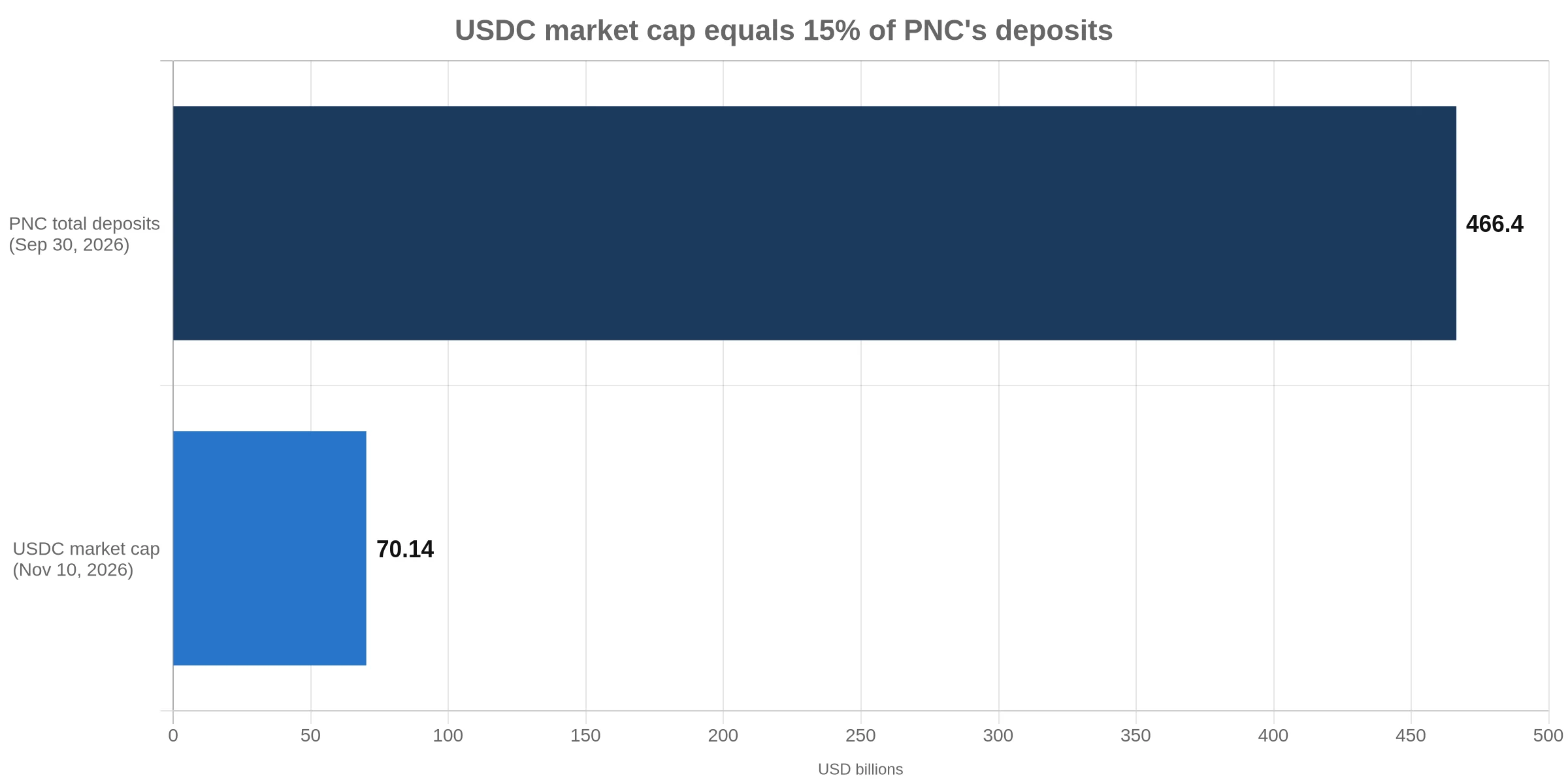
That arithmetic runs both ways. It shows how small the stablecoin channel still is relative to a regional bank’s funding base, and it shows why even a modest shift of corporate settlement into tokens is worth wiring for.
PNC does not need USDC to become a deposit substitute. It only needs a slice of the payment flow that would otherwise clear through a crypto-native processor and never appear as a PNC balance.
The income math is straightforward, if approximate. At the 2.94% net interest margin PNC reported for the third quarter, $1 billion of deposits held at that margin would support roughly $29.4 million of annual net interest income, before funding costs and liquidity rules are applied.
That is an illustration of scale, not a company forecast: PNC has not disclosed expected volumes or pricing for the pilot.
A Pilot With a Narrow Door
The public document is explicit about the limits, and they matter more than the marketing line about cross-border efficiency.
| Question | What PNC has stated |
|---|---|
| Which stablecoin | USDC only |
| Which network | Ethereum only |
| Payment direction | Incoming payments to PNC clients |
| Who can use it | “Eligible clients,” initially on a limited pilot basis |
| Conversion | Automatic, 1-to-1 into dollars |
| Settlement destination | A designated PNC deposit account |
| Fees | Not disclosed |
| Volume or client count | Not disclosed |
| Outbound stablecoin payments | Not announced |
The fees are the most consequential blank. A conversion service can be priced as a treasury product, absorbed into existing payment fees, or run at a loss to win deposit balances. PNC has not said which, and the economics of the rail depend entirely on that choice.
Volume is the second blank. A pilot can run for months on a handful of clients without producing a number anyone outside the bank can verify. Until PNC or Coinbase discloses processed volume, the service is a capability, not a business.
Eleven Months From Bitcoin Trading to Dollar Rails
The November 9 launch is the second step in a sequence that started with wealth clients. In December 2025, PNC became the first major U.S. bank to offer direct spot bitcoin trading to eligible PNC Private Bank clients, using Coinbase’s Crypto-as-a-Service infrastructure. That partnership had been announced in July 2025.
The client base then was high-net-worth individuals buying and holding bitcoin inside the bank’s own platform. The client base now is corporate treasuries receiving dollar stablecoins from counterparties.
The risk profile is different in both directions: the first service put price exposure in front of wealth clients, while the second keeps the bank in dollars and pushes the token handling to its infrastructure partner.
William S. Demchak, PNC’s chairman and chief executive, framed the earlier step as a matter of offering controlled access rather than chasing the market: “As client interest in digital assets continues to grow, our responsibility is to offer secure and well-designed options that fit within the broader context of their financial lives.”
Read together, the two announcements describe a bank building the plumbing in the order that minimises its own exposure. First custody and trading through a partner. Then settlement and conversion through a partner. In neither case does PNC describe a crypto balance sheet of its own.
What Would Show the Rail Has Volume
Four observable signals would separate a real treasury product from a pilot that never scales. The first is an outbound service: a PNC client paying a supplier in USDC through the bank, which turns a one-way collection rail into a two-way settlement network. The second is a second network or asset, since Ethereum-only USDC leaves out clients who settle on cheaper chains.
The third is disclosure. A processed-volume figure, even a rounded one, would let the market size the channel against the $12.46 billion in USDC that changes hands every day. The fourth is imitation: if the model works, other large U.S. banks with the same Coinbase relationship have the same incentive to switch it on, and PNC’s first-mover framing from December 2025 stops being a differentiator.
The backdrop matters for timing. Stablecoin supply shrank $6.7 billion in a week in early November, the steepest drop of 2026, which means the float PNC is wiring for is currently contracting rather than expanding. Coinbase, meanwhile, won a final OCC trust charter on November 9, the same day as the PNC launch, giving the infrastructure partner a federal banking foothold of its own.
None of that changes what PNC built. A corporate client can now be paid in USDC and end the day holding dollars at a bank that never touched the token. The interesting question is not whether that is convenient. It is whether the dollars stay.
Disclosure: This article does not represent investment advice. The content and materials featured on this page are for educational purposes only.