

Bitcoin miner selling pressure has fallen sharply, with BTC inflows from miners to Binance dropping to levels not seen since mid-2023. The shift matters because miner distribution is one of the market’s more persistent sources of structural sell-side pressure, and the latest data suggests that pressure has eased for now.
In a post via X on Sunday, CryptoQuant contributor Darkfost said the monthly average of BTC inflows from miners to Binance has fallen to roughly 4,316 BTC. When the same activity is measured across all exchanges, the figure rises only slightly to 4,381 BTC, reinforcing the point that the slowdown is not limited to a single venue.
Bitcoin Miner Selling Pressure Drops
The reversal follows a brief spike earlier this year tied to extreme weather in the United States. According to Darkfost, miner inflows picked up during the ice storm that hit the country in late January and early February, when several large US-based mining pools were forced to scale back or temporarily suspend operations. That disruption, he argued, likely translated into heavier BTC sales as miners worked to cover ongoing expenses despite reduced output.
“It is important to recall that during this weather event, several large US based mining pools were forced to slow down or temporarily halt their operations,” Darkfost wrote. “Even when activity is reduced, however, fixed costs remain high, including electricity, infrastructure, and operational expenses. This situation likely pushed some miners to increase their BTC sales in order to maintain liquidity.”
That dynamic now appears to have faded. “Since then, the trend has clearly reversed,” he added, describing current inflows as having fallen to “historically low levels.” He noted that a similarly weak reading for miner transfers to Binance was last seen on June 5, 2023.
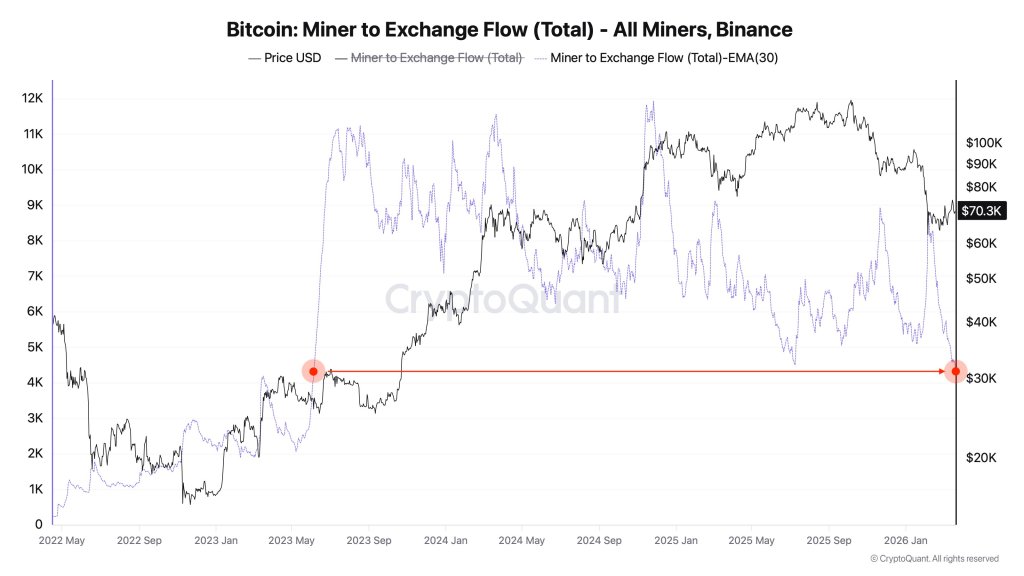
The broader implication is straightforward: miners are currently sending less BTC to exchanges, which in turn suggests they are selling less into the market. Darkfost framed that as a constructive development, writing that “the current decline in inflows suggests that miners have significantly reduced their BTC sales, which can be interpreted as a constructive signal for the market, as structural selling pressure from this cohort appears to be temporarily easing.”
That does not mean the risk has disappeared. Darkfost estimates that miners still hold around 1.8 million BTC in reserves, a stockpile large enough to matter if market conditions change and distribution accelerates again. In other words, the absence of aggressive selling is supportive, but it is not the same as a supply overhang vanishing altogether.
Related Reading: Bitcoin Risks Drop To $52,000, Veteran Analyst Aksel Kibar Says
The miner data also arrives alongside signs that Bitcoin is still trying to rebuild a firmer base among short-term holders . In a separate post, Darkfost said the market has spent nearly a month attempting to stabilize above the cost basis of the youngest short-term holder cohort, the 1-week to 1-month group. That cohort’s estimated breakeven level sits at $68,200, making it the only short-term holder segment currently around flat.
Further up the ladder, the pressure points are steeper. The 1-month to 3-month cohort has an estimated cost basis of $83,500, while the 3-month to 6-month group sits even higher at $96,900. Darkfost said the 1-month to 3-month level acted as resistance the last time price approached it, as many short-term holders used the move to exit, pushing the broader short-term holder segment back into unrealized loss.
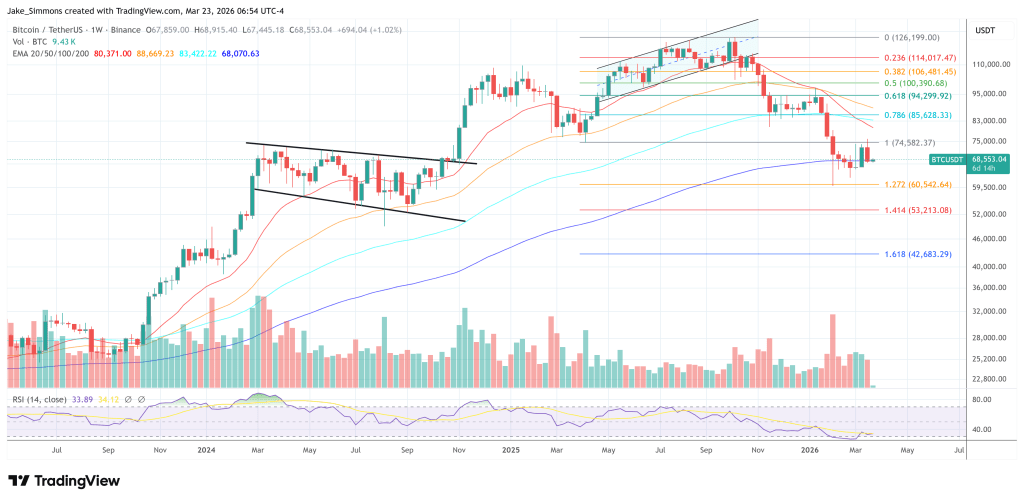
At press time, BTC traded at $68,553.