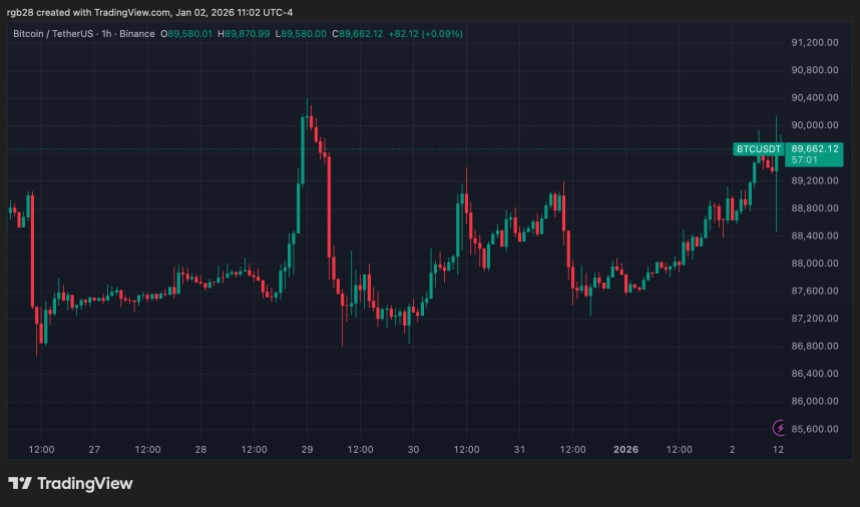
Despite the recent price action, Bitcoin (BTC) closed 2025 as the year with the lowest volatility in its history, driven by market maturity, regulatory developments, and the increasing participation of institutions in the crypto space.
Bitcoin Records Least Volatile Year
On Friday, K33 Research data revealed that Bitcoin has recorded the least volatile year in the asset’s history. According to the chart, the flagship cryptocurrency saw its lowest volatility level, measured by the average deviation of daily returns, in 2025, hitting just 2.24%.
The recent data shows that BTC fell below the previous lowest year on record, 2023, which registered 2.30% volatility. Moreover, it’s annual volatility has also ended below the 3% mark over the past three years, its lowest levels since 2016.
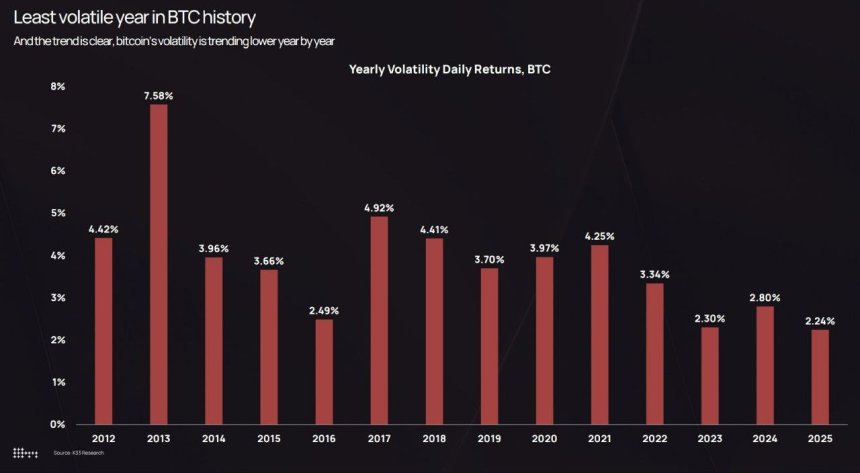
This signals a “clear” diminishing trend, K33 Research noted, as Bitcoin’s volatility has been trending lower year by year, suggesting growing market maturity and stabilizing price action.
Crypto trader Niels highlighted that “for the first time, BTC recorded its lowest annual volatility on record, lower than every cycle before it, including the early ‘wild west’ years and the post-ETF era.”
As he explained, 2025 was “the calmest year in Bitcoin’s history” despite all the price movements of the years, including the Q4 daily corrections, which saw the flagship crypto retrace up to 16% in a single day.
It’s worth noting that BTC’s deepest correction in 2025 saw the cryptocurrency drop nearly 36% in a two-month period, while previous cycles’ corrections recorded retraces of more than 50% during similar periods.
Previously, Nic Carter addressed the negative sentiment brewing around Bitcoin and the broader market. He detailed that the market could be considered “boring” now because most of the questions that drove the historical volatility have been answered. Carter also asserted that the space matured significantly with “more serious businesses (…), [and] less chaos” in the industry.
The Start Of The ‘Institutional Era’
In his X post, Niels also pointed out that the diminishing trend in Bitcoin volatility was fueled by the massive institutional participation, calling for “More capital. More long-term holders. More institutional participation. [and] Less emotional trading” for the future.
Similarly, Bitwise’s CEO, Hunter Horsley has affirmed that the overall crypto market was changing, driven by the significant decrease in regulatory risk, which has led to last year’s spike in institutional adoption and mainstream recognition.
Notably, the market saw the second of wave of crypto Exchange-Traded Funds (ETFs) go live, with funds based on altcoins like Solana (SOL) and XRP breaking multiple records. In addition, the Digital Asset Treasury (DAT) trend, led by Strategy’s Bitcoin purchases, poured billions of dollars into cryptocurrencies in 2025.
In November, Ark Invest’s CEO Cathie Wood stated that growing institutional adoption will be a powerful driver for long-term value for Bitcoin, noting that large-scale institutions have barely dipped their toes into the space and “have a long way to go.”
Meanwhile, Head of Research at Grayscale, Zach Pandl, said in an January 2 interview that 2026 could be the “dawn of the institutional era” for crypto. He noted that rising demand for alternative stores of value and progress on bipartisan US crypto market structure legislation could drive Bitcoin to new highs in the first half of the year.
As of this writing, Bitcoin is trading at $90,240, a 1.54% increase in the daily timeframe.